
Randall County Parole or Probation
Start with the court judgment or TDCJ identity number. That one distinction selects the right office. Texas parole is discretionary release from a TDCJ sentence, subject to conditions for the balance of the term. Mandatory supervision is a statutory TDCJ release route based on calendar time and eligible good-conduct calculations, though offense exclusions and Board review can apply. Probation, called community supervision in Texas law, is ordered by the sentencing court and managed locally.
A person may begin Randall County probation without entering TDCJ at all. Jail credit also does not turn probation into parole. By contrast, the Texas Board of Pardons and Paroles makes parole decisions, and the TDCJ Parole Division supervises a person once released. These labels must be copied exactly from the source record.
| Status | Decision source | Verification route |
|---|---|---|
| Parole | Texas Board of Pardons and Paroles | TDCJ record, Board status line, then Parole Division |
| Mandatory supervision | Texas law and Board process where applicable | TDCJ and Parole Division |
| Probation | Sentencing court | Randall court record and Adult Probation |
| Discharge | Responsible supervising authority | Final agency or court record |
Verify Randall County Release Supervision
A reliable check separates four stages: incarcerated and awaiting review, approved but still confined, physically released to parole or mandatory supervision, and discharged. The online TDCJ search is primarily a current-prison tool. A missing result after release calls for the telephone, IVSS, Parole Division, or formal records route rather than a guess.
For a county case, preserve the cause number and court named on the judgment. Court entries can show community supervision, amendments, revocation allegations, and final disposition, but they do not replace the supervising office's current status. For a TDCJ case, preserve both TDCJ and SID numbers because those identifiers work better than spelling variants. If a release record names another authority, verify that destination before treating the person as living under local supervision.
- Use the judgment to decide whether the order is probation, or use the TDCJ or SID number for a state-prison case.
- For a person still incarcerated, search the TDCJ Inmate Information Search and read parole review and decision fields literally.
- Before a Board vote, call the review-status line at 844-512-0461. After a favorable vote, call the release-status line at 512-406-5202.
- After physical release, contact the Amarillo District Parole Office or TDCJ IVSS for the proper state supervision channel.
- For probation, use the Randall court case to identify the order, then call Randall County Adult Probation at 806-468-5691.
Names alone are weak identifiers. Compare date of birth, cause number, TDCJ number, SID, offense, and sentencing court when those fields are lawfully available. The broader Randall County released inmate search explains how a county release record and court docket fit around this supervision check.
Randall County Parole Review Stages
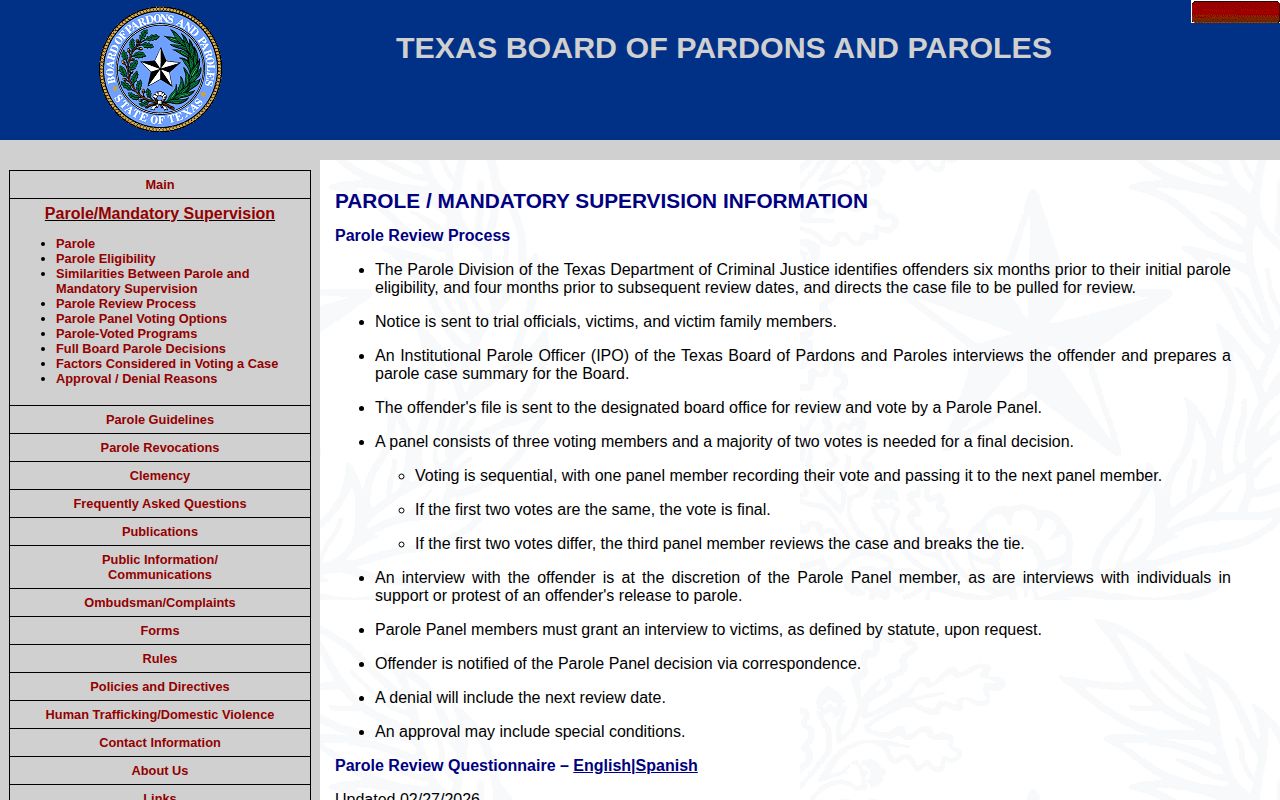
The Board review process begins before eligibility. TDCJ identifies cases six months before initial eligibility and four months before a later review. An Institutional Parole Officer prepares a case summary, then a three-member panel votes in sequence. Two matching votes decide the case. A denial supplies a later review date; an approval can carry a future date, treatment, or program condition.
Open-government meeting notices are not a person-by-person hearing calendar. Ordinary parole review is usually an administrative file review, not a public courtroom hearing. The current-inmate detail, Board status line, and correspondence are the person-specific sources. A vote code such as FI-1 means release when eligible, while other FI codes can require a later date or program. None proves that the person has crossed the prison gate.
The official Board parole review page illustrates the sequence used before a decision.
Randall County Parole Office
The Amarillo District Parole Office is the local navigation point for a person released to TDCJ parole or mandatory supervision in the Amarillo area. It is not a public directory of every supervisee, and protected case details may not be disclosed. Call with a TDCJ or SID number when possible.
Amarillo District Parole Office
Address: 5809 South Western Street, Suite 120, Amarillo, TX 79110
Phone: 806-355-9218
Fax: 806-353-9572
Directory contact: Nicole Brooks
For general inmate information, TDCJ lists 936-295-6371 and 800-535-0283, with published weekday hours of 8 a.m. to 5 p.m. Those lines address state custody. They should not be used to answer a routine Randall County bond release.
Randall County Probation Records
Randall County Adult Probation belongs to the local Community Supervision and Corrections Department, not the Board. Start with the Randall court portal to locate the judgment, sentencing court, probation term, and later docket events. Then use the county directory’s Adult Probation number, 806-468-5691, for routing. The court order is stronger than an inference drawn from a jail roster.
A probation record may show conditions, payment or reporting duties, amendments, completion, or revocation activity. Court records document legal events, but they do not necessarily establish the minute a person left the Randall County Jail. If actual release time matters, pair the judgment with the jail booking-out record.
Probation status should be tied to the exact sentencing case. One person may have more than one cause, and a completed term in one cause does not resolve another. Ask for the judgment, any order modifying conditions, and the order that records completion or revocation. When the docket uses “community supervision,” that is the Texas court term for probation. It does not mean TDCJ parole, even when county jail credit appears in the judgment.
Randall County Warrants and Violations
TDCJ’s Warrants Section runs a continuous command center and handles parole-warrant entries in law-enforcement databases. Those systems are not a public statewide absconder list. A missed appointment does not automatically create a warrant. Verify through the supervising office, and do not assume an active parole warrant places the person in Randall County Jail.
When a supervised person is detained, preliminary or revocation proceedings may follow. Outcomes can include continued supervision, added sanctions, placement in an intermediate facility or program, or revocation and return to prison. The Board says revocation decisions commonly take two to four weeks after a hearing and are delivered through the Parole Division.
A warrant entry, revocation hearing, and revocation decision are separate events. Ask which one the source reports. A county jail listing can confirm present local custody, but it cannot by itself establish the reason for a parole hold or the final Board outcome. A Board notice may establish a supervision decision without proving current physical location. Pair records only when identifiers agree.
- Absconder
- A supervised person alleged to have stopped reporting or left required oversight.
- Revocation
- An official decision ending community supervision and imposing an authorized custody result.
- Discharge
- The recorded end of the sentence or supervising agency obligation.
- Detainer
- A request or hold from another authority that can prevent community release.
Randall County Supervision Discharge
Release to parole or mandatory supervision leaves a person under TDCJ authority. Discharge is later and ends the agency obligation shown in the final record. Probation ends through the court and local supervision process. Neither should be inferred from silence in a current roster.
Ask the agency for the exact status and effective date. If an old online record conflicts with a current order, preserve both and seek clarification from the record owner. Texas IVSS can provide status notices, but certified proof comes from the TDCJ discharge record, Parole Division, court, or Randall CSCD as appropriate.
Conditions can continue until the formal end date even when routine reporting changes. A transfer between district offices is not discharge. Nor does the end of jail custody erase an active court case or supervision term. Request the final order or agency record if the distinction affects a visit, ride, court appearance, or records request. Parole, mandatory supervision, probation, and discharge each point to a different status.
Public Record Search
Sponsored Results